Silk Roads Again Revisiting Roads Connecting Eurasia
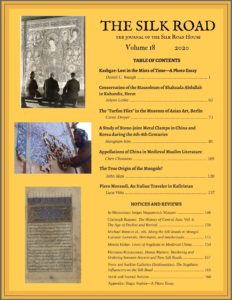
I am delighted to denote the publication of Vol. 18 (2020) of The Silk Route. After a trying and oftentimes traumatic year that disrupted many of the normal rhythms and cycles of academic life, a return to normalcy is finally on the horizon. It is perhaps fitting then that the latest volume of The Silk Road looks not only back in time, just besides to the future. In addition to fascinating manufactures on the aboriginal peoples and monuments of the Silk Route—stone-joint metal clamps in Communist china and Korea, medieval Muslim conceptions of "China," the conservation of a mausoleum in Transitional islamic state of afghanistan—information technology also presents insightful piece of work on the modern Silk Roads: the German expeditions to Turfan, urban modify in Kashgar, Mongol tourism in People's republic of china, and Italian ethnographers in Transitional islamic state of afghanistan. A remembrance of the great Sergei Stepanovich Miniaev reminds us of those we have lost over the past twelvemonth. Rounding out the volume is our usual collection of volume reviews and notices, including an overview of the innovative digital exhibition on the Sogdians hosted by the Freer and Sackler Galleries.
Kashgar: Lost in the Mists of Fourth dimension—A Photograph Essay
Daniel C. Waugh
Conservation of the Mausoleum of Shahzada Abdullah in Kuhandiz, Herat
Jolyon Leslie
The "Turfan Files" in the Museum of Asian Art, Berlin
Caren Dreyer
A Study of Stone-joint Metallic Clamps in China and Korea during the 6th-eighth Centuries
Hongnam Kim
Appellations of China in Medieval Muslim Literature
Chen Chunxiao
The True Origin of the Mongols?
John Man
Piero Morandi, An Italian Traveler in Kafiristan
Luca Villa
Keep reading
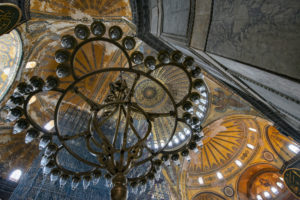 The Hagia Sophia is i of the oldest sites of continuous worship in the world and an iconic symbol of cultural exchange across Eurasia. Since its founding in the yr 537, the Hagia Sophia has alternately served as a Christian church and Islamic mosque for many centuries. In 1935, it was turned into a museum, which is now visited by millions of people every year. In July 2020, it was once more converted back into a mosque, thereby eliciting a wide range of reactions from the global community. In response to this renewed attention—and in some cases controversy—our quondam editor Daniel C. Waugh has taken the opportunity to revisit his voluminous photographic archives and has assembled an engaging photo essay about the art, compages, and history of the Hagia Sophia. To admission the full essay, please click here.
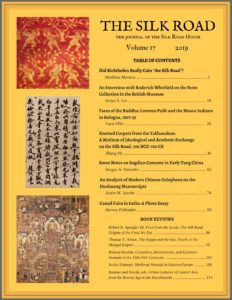 It gives me swell pleasure to denote the publication of Vol. 17 (2019) of The Silk Road. Nosotros brainstorm with a critical re-examination of Richthofen'south vaunted distinction as the inventor of the phrase "the Silk Road" and an in-depth interview with Roderick Whitfield on his career working with the Stein collection in the British Museum. Next up are stimulating features on the forgotten history of the Museo Indiano in Bologna, knotted carpets and cultural exchange along the Taklamakan, Sogdian fashions in early on Tang Prc, modern Chinese colophons on the Dunhuang manuscripts, and a photo essay on camel fairs in India. Book reviews by Susan Whitfield, Samuel Rumschlag, Charles J. Halperin, and Barbara Kaim follow.
From the Editor
Did Richthofen Really Coin "the Silk Road"?
Matthias Mertens
An Interview with Roderick Whitfield on the Stein Collection in the British Museum
Sonya S. Lee
Faces of the Buddha: Lorenzo Pullè and the Museo Indiano in Bologna, 1907-35
Luca Villa
Knotted Carpets from the Taklamakan: A Medium of Ideological and Artful Exchange on the Silk Road, 700 BCE-700 CE
Zhang He
Some Notes on Sogdian Costume in Early Tang China
Sergey A. Yatsenko
An Analysis of Modern Chinese Colophons on the Dunhuang Manuscripts
Justin Thousand. Jacobs
Camel Fairs in Bharat: A Photo Essay
Harvey Follender
Go on reading
It gives me bully pleasure to introduce Book 16 of The Silk Road. After more than fifteen years in the capable hands of longtime editor Daniel C. Waugh, The Silk Route baton has now passed into my hands. Much like parenthood, the responsibleness of managing an annual periodical is equal parts both blessing and brunt, the latter marked past daily anxieties so consuming equally to occasionally disrupt one's evening slumber. And then come the modest triumphs that remind u.s.a. why we got into this business concern in the first place: the production of fresh knowledge and broadcasting of exciting new discoveries derived from the lands and peoples who continue to animate the historical rubric of the Silk Route.
The latest volume of The Silk Road fully lives upwards to this hope. Our excursion through place and time begins with a fascinating archaeological report past Marina Kulinovskaya and Pavel Leus on recently excavated Xiongnu graves in Tuva, lavishly illustrated with nearly 50 color photographs from the field. We are and so treated to Jin Noda's analysis of Japanese intelligence agents in Russian and Qing Inner Asia during the tardily nineteenth and early twentieth centuries. Next up is Zhang Zhan's in-depth reassessment of ancient Sogdian documents from Khotan and what they can tell us well-nigh the status and occupations of these far-flung travelers during the beginning millennium CE. Zhang's philological analysis is followed by Li Sifei's investigation into the complex field of study of Chinese perceptions of "Persians" and "Sogdians" during the Northern Zhou, Sui, and Tang dynasties. Marina Rodionova and Iakov Frenkel' and then encourage usa to transfer our attention to the other, far less popularized cease of the Silk Route, with a detailed case report of how a Mongol-era Chinese celadon fabricated its mode to the Novgorod Kremlin in Russia. Continue reading
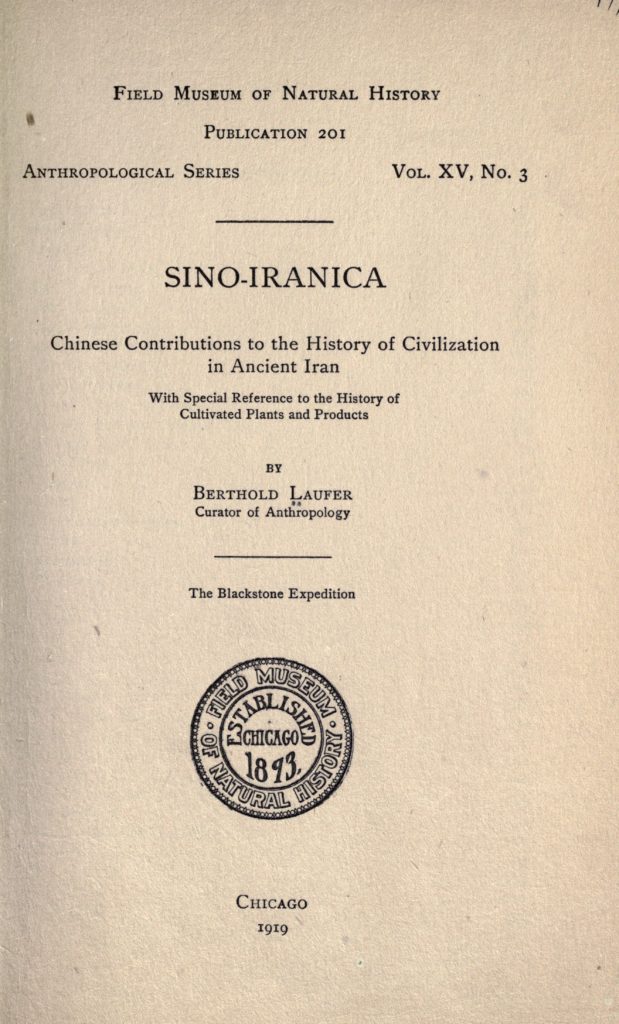 The international scholarly yearbook Quaderni di Studi Indo-Mediterranei (whose editor is the Iranologist Prof. Carlo Saccone at the Academy of Bologna) devotes each book to a different theme. Vol. 12 (2019) of QSIM is scheduled to appear in 2020. Its theme is "Sino-Iranica's Centennial. Betwixt East and West: Exchanges of Material and Ideational Culture. Commemorating the publication, in 1919, of Sino-Iranica by Berthold Laufer (1874–1934)."
Laufer showed the importance of contacts between the Iranic globe and Red china as reflected in the exchange of items of material civilisation, and this also involved exchanges between Islamic republic of iran and more western cultures, such as the Graeco-Roman world, and Syria. Moreover, he also showed how merchandise with India and Indo-Cathay percolated into such exchanges. Proceed reading
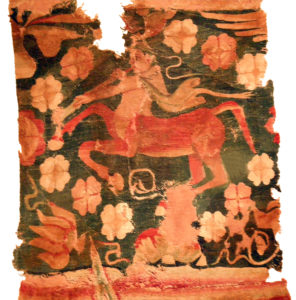
Buddhist sculpture from Gandhara is in a sense well known, but there is nonetheless much to be learned from it. Ulf Jäger (independent scholar, Germany) analyzes the sculpted imagery on a necklace, which leads into the field of study of how centaurs are to exist institute across Eurasia and how the perception of them changed.
Click here to download the full PDF
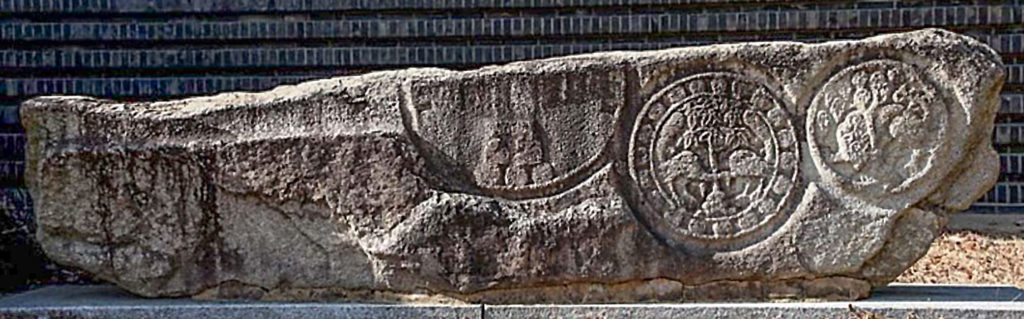
A carved granite slab in the Gyeongju National Museum in Korea has images in roundels whose iconography suggests widely ranging connections to the West in the Unified Silla period. Hongnam Kim (Asia Museum Found, Korea) analyzes the Western influences of this iconography, concluding that it is likely that the craftsman who executed the piece of work was familiar with Christian imagery.
Click here to download the full PDF
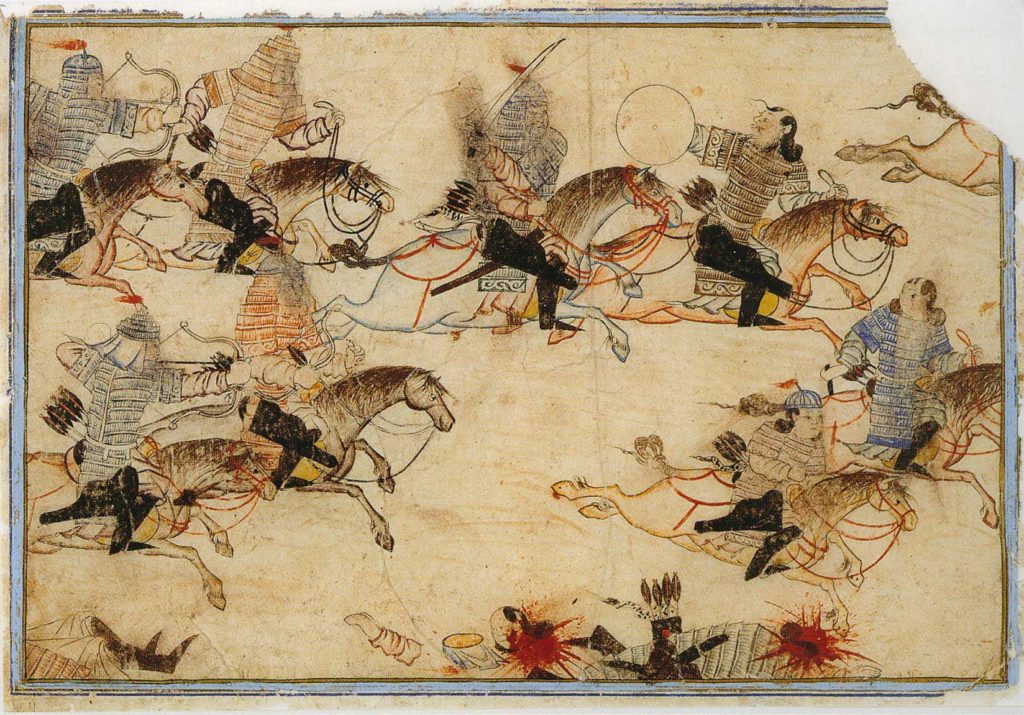
When the Oirad Mongols defeated the Ming and captured their emperor at Tumu in 1449, they could accept invaded Central Prc and perhaps brought downward the nonetheless young Ming land, but did non. Past examining the significance of the Chinggisid legacy both for the Mongols and the Ming, Johan Elverskog (Southern Methodist University) explains why.
Click here to download the full PDF
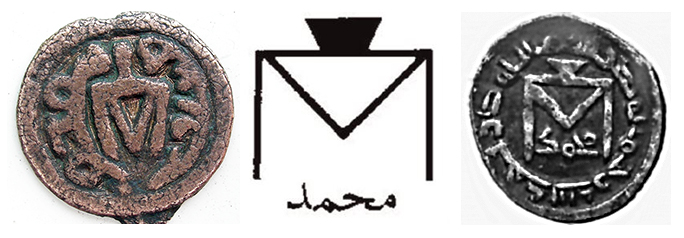
Slave soldiers from Central Asia often rose to power in the Islamic world. Jere Bacharach (University of Washington, Seattle) analyzes i of the rulers of Egypt in the tenth century CE who sought to emphasize his Fundamental Asian family heritage in his titulature and coinage.
Click here to download the full PDF
Source: https://edspace.american.edu/silkroadjournal/
0 Response to "Silk Roads Again Revisiting Roads Connecting Eurasia"
Postar um comentário